
 Statistics
241 human active and 13 inactive phosphatases in total;
194 phosphatases have substrate data;
--------------------------------
336 protein substrates;
83 non-protein substrates;
1215 dephosphorylation interactions;
--------------------------------
299 KEGG pathways;
876 Reactome pathways;
--------------------------------
last scientific update:
11 Mar, 2019
194 phosphatases have substrate data;
--------------------------------
336 protein substrates;
83 non-protein substrates;
1215 dephosphorylation interactions;
--------------------------------
299 KEGG pathways;
876 Reactome pathways;
--------------------------------
last scientific update:
11 Mar, 2019
DEPOD User Manual
Tips: |
1. Mouse-over  icon to get hints about various fields while exploring DEPOD-2019 icon to get hints about various fields while exploring DEPOD-2019 |
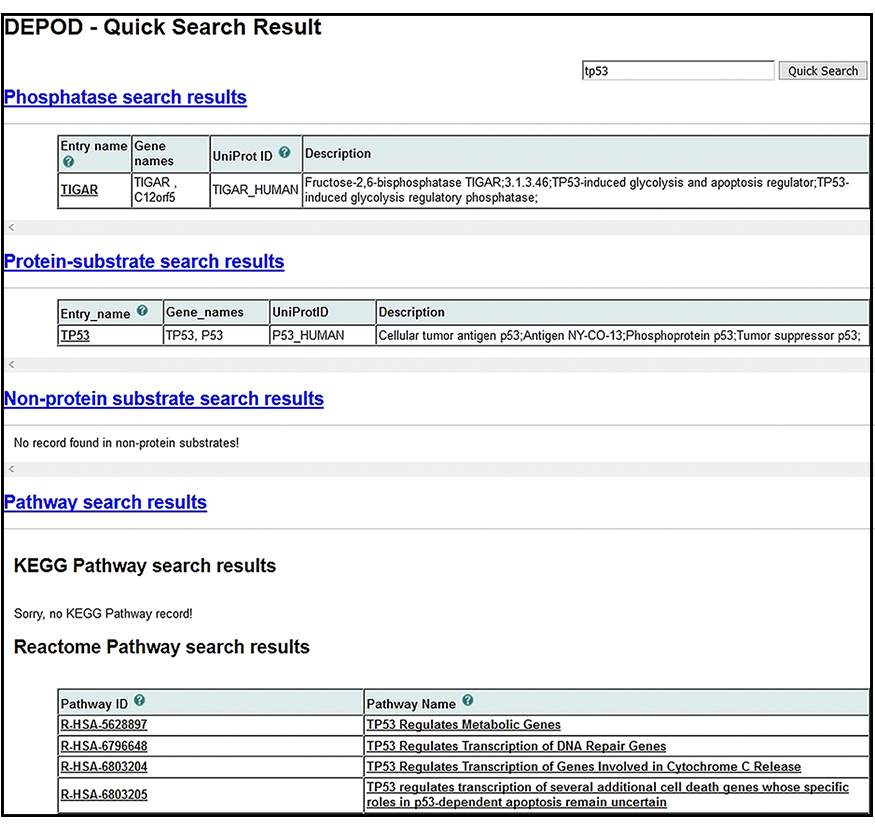
| 2. Use Quick Search to search for phosphatases, substrates, or pathways in DEPOD-2019. |
Top
Index:
1. Search DEPOD-2019
2. Browse DEPOD-2019
3. Protein annotations in DEPOD-2019
4. Non-protein annotations in DEPOD-2019
5. Pathway-mapping in DEPOD-2019
1. Search DEPOD-2019
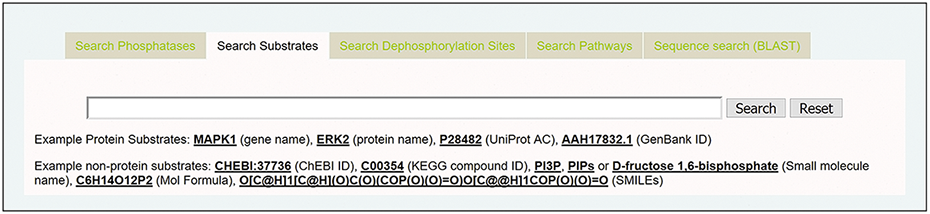
DEPOD-2019 allows you to search for - phosphatases, substrates (both protein and non-protein), dephosphosites, pathways and protein sequences. It also provides a Quick Search utility on every page in the top-right corner.
Click on the following tabs to see the search-interface and the output.
- Search phosphatase
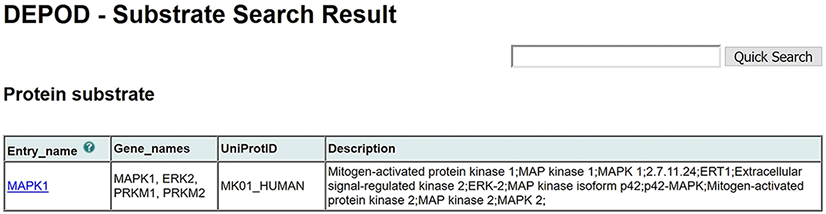
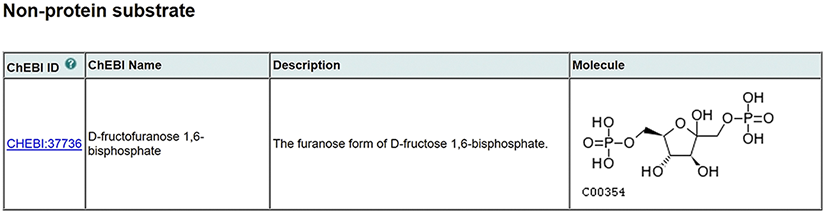
- Search substrate
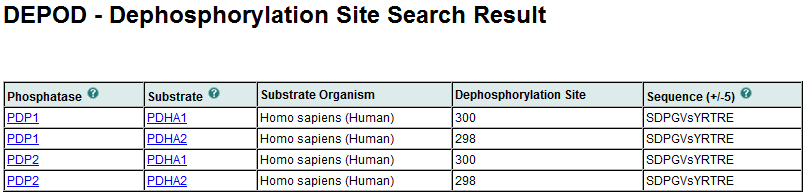
- Search dephosphorylation site
- Search pathway
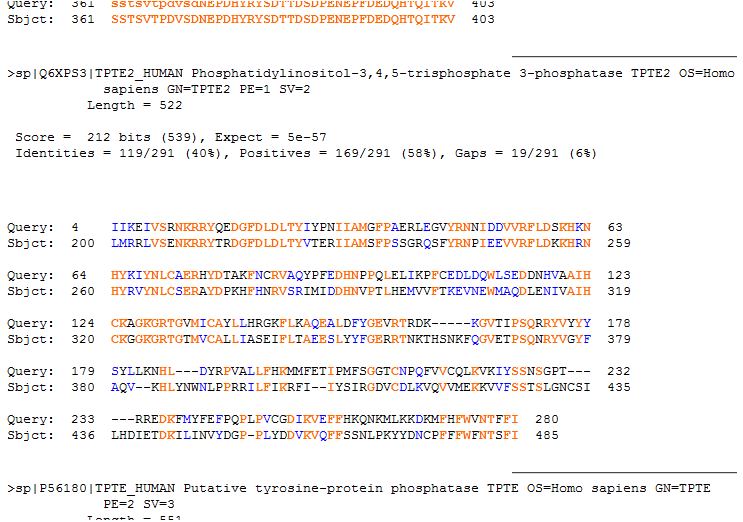
- Sequence search
- Quick search
Search Interface |
 |
Output |
 |
Click of the entry name to go to the corresponding protein entry |


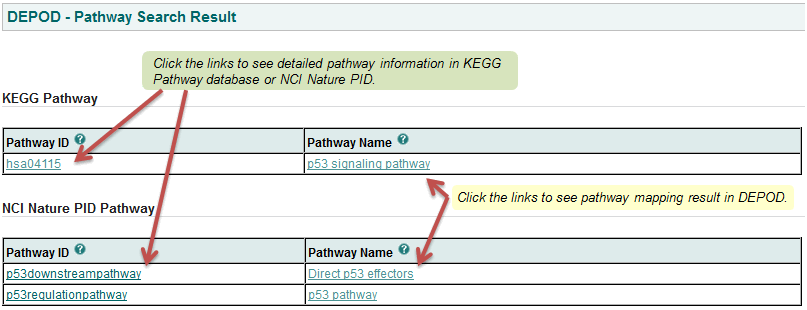
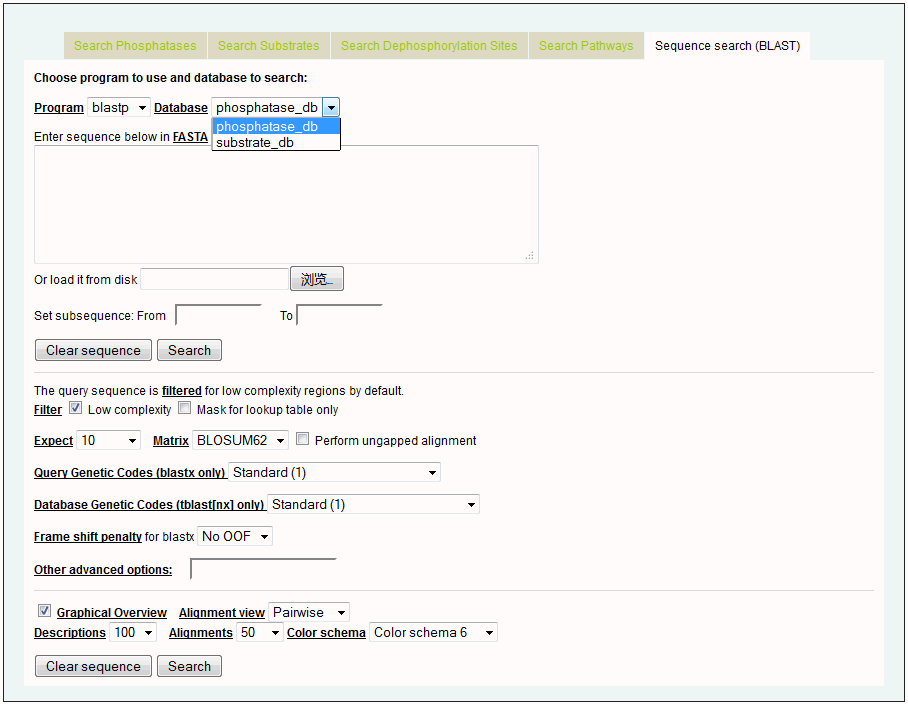
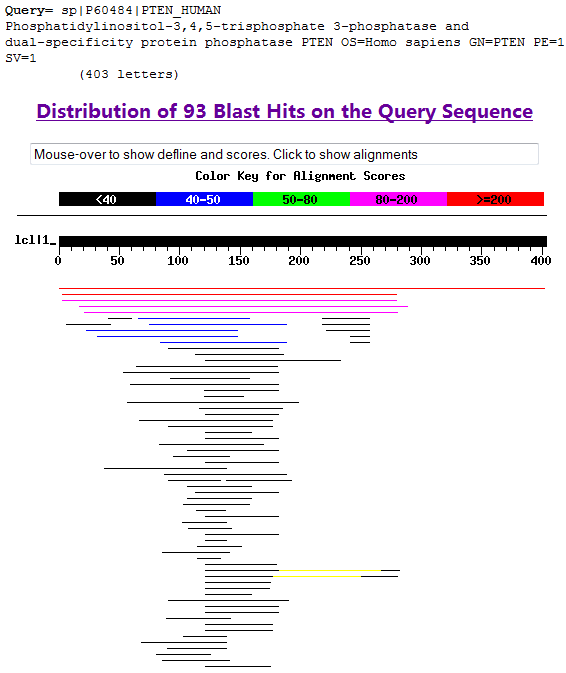
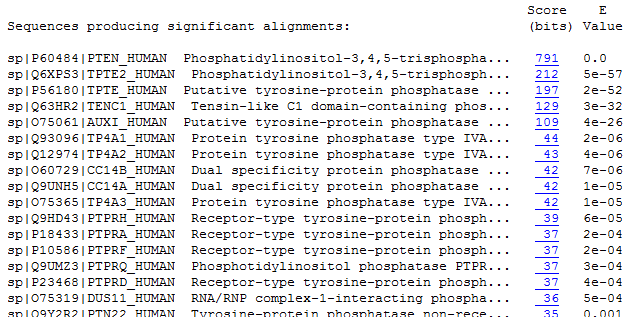
Click on the following tabs to see the browsing interfaces of DEPOD-2019.
- Browse phosphatases
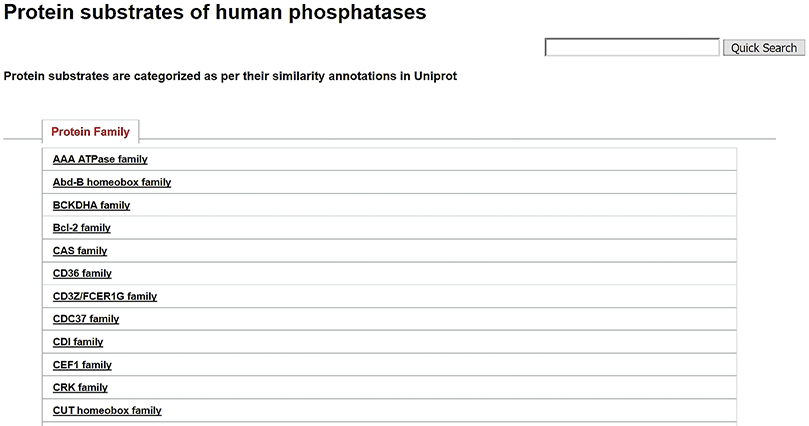
- Browse protein substrates
- Browse non-protein substrates
- Browse pathways
- Browse phosphatase-substrate network
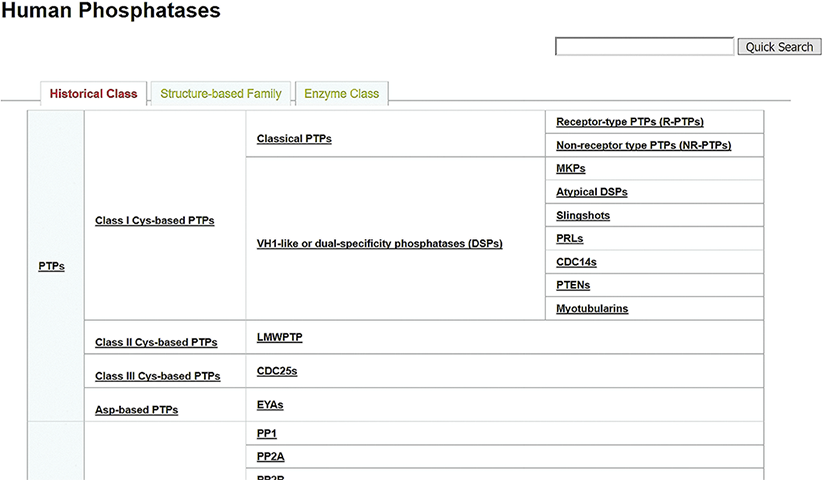
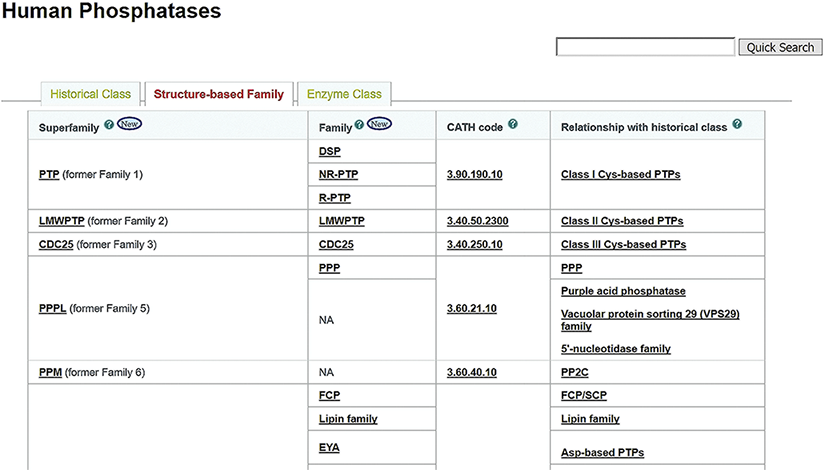
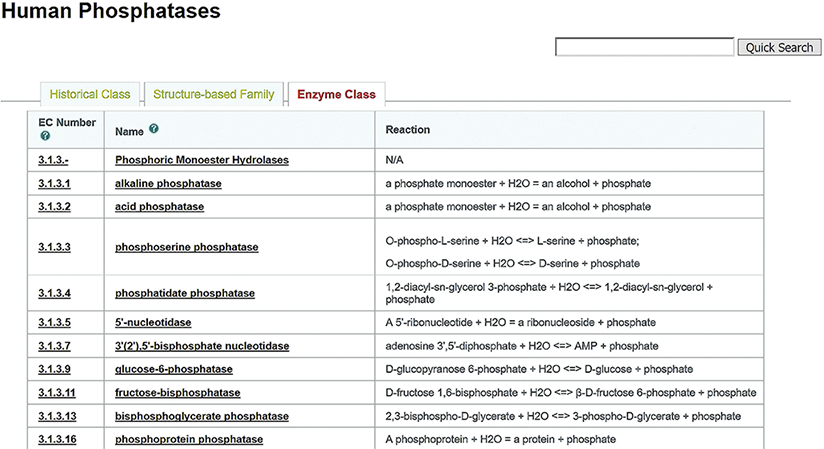
| Browse human phosphatases | Human phosphatases can be accessed using their historical classification, structure-based (CATH) classification or EC-number based classes |
 |
 |
 |
|
 |

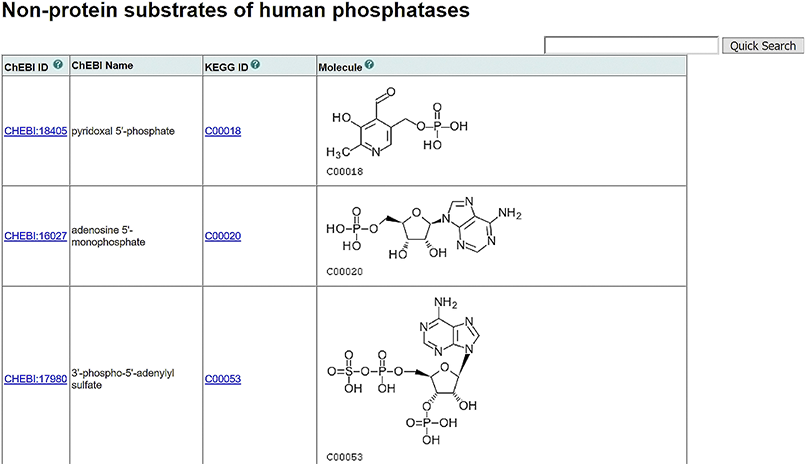

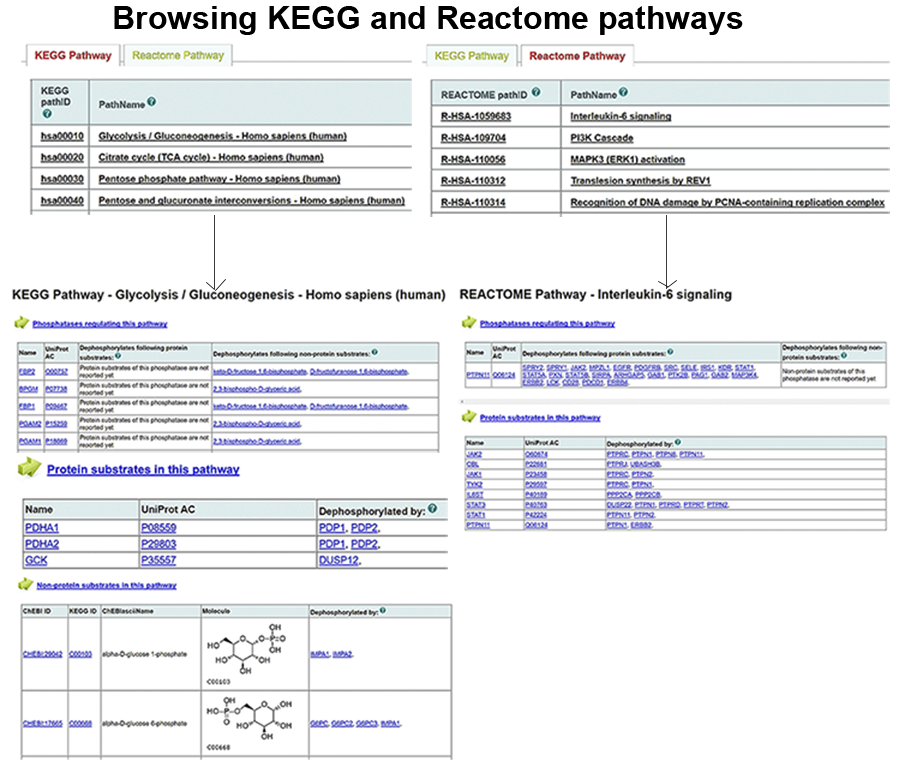

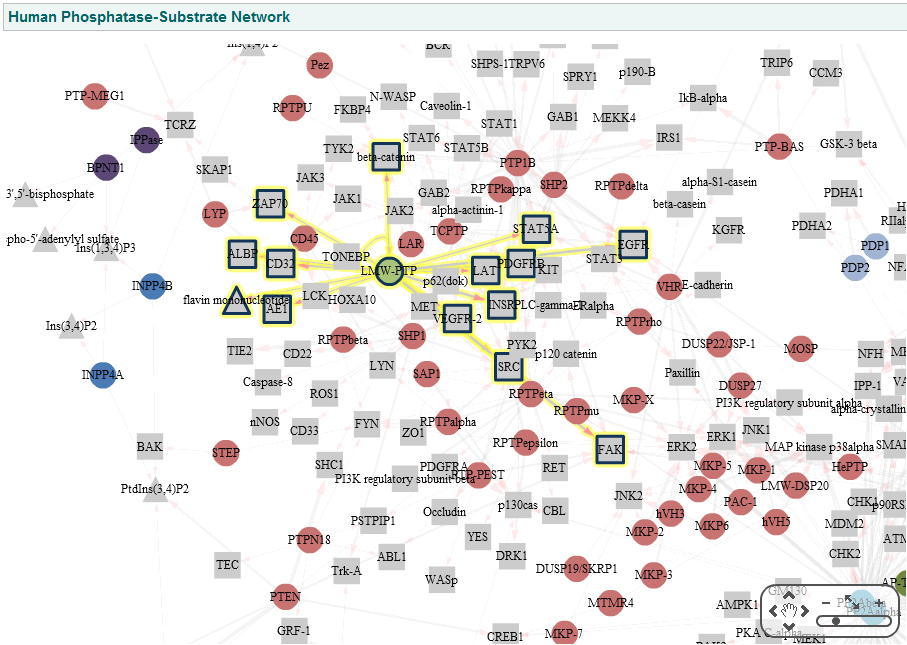

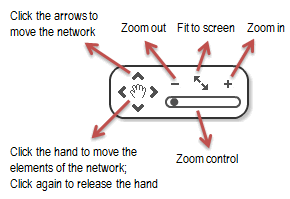
Click on the following tabs to see the annotations provided under each tab in DEPOD-2019.
| Gene Name | Gene name is the approved gene symbol from HGNC (HUGO Gene Nomenclature Committee). Click the link to see gene name information in HGNC. Click the link "QuickGO" to see Gene Ontology terms and annotations provided by the UniProtKB-GOA group at the EBI. |
| Synonyms | Gene synonyms |
| Protein Name | Protein name |
| Alternative Name(s) | Protein names from UniProt annotation |
| EntrezGene ID | Gene ID in the EntrezGene database |
| Comparative Toxicogenomics | Link to the manually curated information about chemical–gene/protein interactions, chemical–disease and gene–disease relationships in CTD database |
| UniProt AC (Human) | Protein entry in the UniProt database (Homo sapiens) |
| Enzyme Class | Enzyme Commission number (links to the BRENDA database - the main collection of enzyme functional data available to the scientific community.) |
| Molecular Weight | Molecular weight of the protein in Daltons |
| Protein Length | Protein length (number of amino acids) |
| Genome Browsers | Visualize the gene in four genome browsers - NCBI, Ensembl, UCSC and 1000Genomes |
| Crosslinking | Annotations from 69 external databases |
| Orthologues | Evolutionary conservation of the protein across different species from Quest for Orthologues (QFO), Genetree and eggNOG (if available) visualized in ProViz |
| Classification | Family-level classification of protein phosphatases. Historical class of the phosphatase and the CATH-based classification as implemented in DEPOD along with the CATH and SCOP IDs |
| Phosphatase activity status | Annotations whether the phosphatases are catalytically active or not as reported in Alonso A and Oulido R, 2015, FEBS J. Catalytic signature motifs in protein Tyr-phosphatases (PTPs) are annotated as such. |
| Phosphonetwork visualization | Cytoscape visualization of the phosphatase-substrate-kinase network in a random layout. Protein kinases (purple squares) phosphorylating the protein of interest (blue triangle) and the phosphatases (orange circles) that dephosphorylate it can be visualized here. Nodes are connected via non-directed non-weighted edges. Click on these nodes to get information about that gene from the NCBI-Gene database. Drag and/or scroll the network using your mouse. |
| Protein Domain | Protein domain composition as defined in InterPro (an integrated database of predictive protein "signatures" used for the classification and automatic annotation of proteins and genomes), the SMART database (focuses on signaling domains, uses their own individual models and domain-specific cut-offs to define domain boundaries) and the Pfam database (a large collection of protein families, each represented by multiple sequence alignments and hidden Markov models (HMMs)). |
| Polypeptide organization | Schematic representation of the Pfam domains within the protein of interest. Click on a domain to see additional information about it in Pfam. |
| Interactive structure visualization | PDB Structures of proteins as reported in UniProt can be loaded one-by-one using the load button and visualized in Web3DMol. |
| 3D Structure | Links to PDB (experimental structure database); DrugPort (providing an analysis of the structural information available in PDB relating to drug molecules and their protein targets); ModBase and SwissModel (theoretical structure model databases). |
| Catalytic Site | Link to the Catalytic Site Atlas (CSA) - a database documenting enzyme active sites and catalytic residues in enzymes of 3D structure. |
| Gene Expression | Link to the Gene Expression Atlas, which is a semantically enriched database of meta-analysis based summary statistics over a curated subset of ArrayExpress Archive, servicing queries for condition-specific gene expression patterns as well as broader exploratory searches for biologically interesting genes/samples. |
| Diseases | Link to the OMIM - Online Mendelian Inheritance in Man (a comprehensive compendium of human genes and genetic phenotypes focusing on their inter-relationships. It is updated daily, and the entries contain copious links to other genetics resources), DisGeNet (discovery platform containing genes and variants in them associated to human diseases), COSMIC - Catalogue Of Somatic Mutations In Cancer (a comprehensive resource for exploring the impact of somatic mutations in human cancer) and ClinVar (a public archive of reports of the relationships among human variations and phenotypes, with supporting evidence). |
| Protein-protein Interaction Database | Links to four popular protein-protein interaction databases (BioGRID, STRING, IntAct and MINT). The interacting partners can be easily explored to find potential dephosphorylation interactions and study the phosphatase in a systematic way. |
| Phosphosites | Links to two major phosphosite databases - PhosphoSitePlus and PhosphoELM - so as to see which sites in the given proteins are experimentally characterized phosphosites and potential kinases in some of these cases. |
| Localization | The localizations are retrieved from UniProt annotations. |
| Function (UniProt annotation) | Protein functions from UniProt annotations |
| Catalytic Activity (UniProt annotation) | Protein catalytic activities from UniProt annotations |
| Protein Sequence | Protein sequence in FASTA format. |
| ELM Motifs | Short Linear Motifs (SLiMs) occurring in the protein predicted as true positive hots according to the Eukaryotic Linear Motif (ELM) database. The boundaries of the motif instance in that protein along with the general regular expression of the motif is also provided. Click on the motif instance to visualize its conservation using ProViz. |
| Gene Ontology ID | Gene Ontology IDs |
| Gene Ontology Term | Gene Ontology terms. P: Biological processes, MF: Molecular function terms and C: Cellular component terms. |
 ) - in vitro or in vivo experiments performed by single lab; Score 2 (
4. Non-protein Substrate Entry in DEPOD
Click on the following tabs to see the annotations provided under each tab in DEPOD-2019.
| Name | ChEBI ASCII nomenclature of the chemical substrate name in DEPOD. |
| Synonyms | Other nomenclatures used for the substrate |
| Definition | A brief description of the chemical substrate as provided in ChEBI |
| Molecular Weight | Molecular weight of the substrate |
| Molecular Formula | Molecular formula of the substrate |
| SMILEs | Simplified Molecular Input Line Entry System (SMILES) notation for the substrate |
| InChI | IUPAC International Chemical Indentifier (InChI) of the substrate |
| InChI Key | InChI-based compact hashed code of a chemical compound having fixed length. |
| Crosslinking annotations | Links to other databases are provided. |
5. Pathway mapping result page
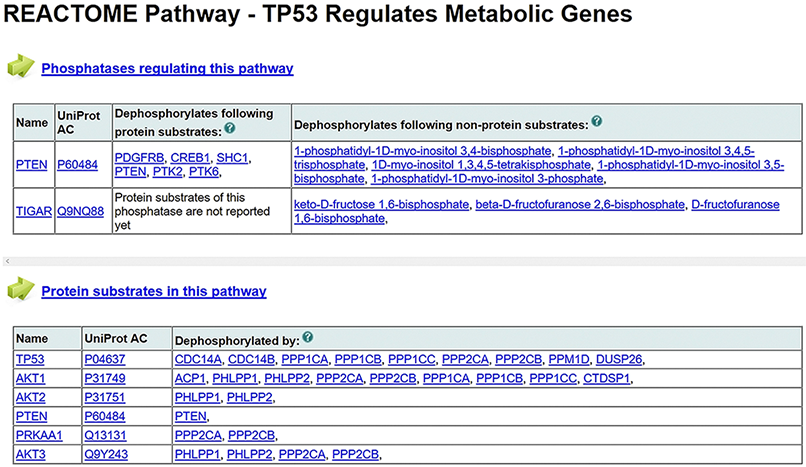
For a given pathway, DEPOD provides phosphatase and their substrates (both protein and non-proteins) involved in that pathway. Following is an example of pathway mapping using one of the reactome pathways.
 |